Pursuant to Article 28(3) of Regulation 2016/679 (the GDPR)
Any questions? Read our FAQ here
Content
2. Preamble
3. The rights and obligations of the data controller
4. The data processor acts according to instructions
5. Confidentiality
6. Security of processing
7. Use of sub-processors
8. Transfer of data to third countries or international organisations
9. Assistance to the data controller
10. Notification of personal data breach
11. Erasure and return of data
12. Audit and inspection
13. The parties’ agreement on other terms
14. Commencement and termination
15. Data controller and data processor contacts/contact points
Appendix A - Information about the processing
Appendix B - Authorised sub-processors
Appendix C - Instruction pertaining to the use of personal data
Appendix D - The parties' regulation of other matters relating to the Data Processing Agreement
Appendix E - Processor chain
2. Preamble
- These Contractual Clauses (the Clauses) set out the rights and obligations of the data controller and the data processor, when processing personal data on behalf of the data controller.
- The Clauses have been designed to ensure the parties’ compliance with Article 28(3) of Regulation 2016/679 of the European Parliament and of the Council of 27 April 2016 on the protection of natural persons with regard to the processing of personal data and on the free movement of such data and repealing Directive 95/46/EC (General Data Protection Regulation).
- In the context of the provision of Evovia Cloud Service, the data processor will process personal data on behalf of the data controller in accordance with the Clauses.
- The Clauses shall take priority over any similar provisions contained in other agreements between the parties.
- Five appendices are attached to the Clauses and form an integral part of the Clauses.
- Appendix A contains details about the processing of personal data, including the purpose and nature of the processing, type of personal data, categories of data subject and duration of the processing.
- Appendix B contains the data controller’s conditions for the data processor’s use of sub-processors and a list of sub-processors authorised by the data controller.
- Appendix C contains the data controller’s instructions with regards to the processing of personal data, the minimum security measures to be implemented by the data processor and how audits of the data processor and any sub-processors are to be performed.
- Appendix D contains provisions for other activities which are not covered by the Clauses.
- Appendix E contains a description of the processor chain.
- The Clauses along with appendices shall be retained in writing, including electronically, by both parties.
- The Clauses shall not exempt the data processor from obligations to which the data processor is subject pursuant to the General Data Protection Regulation (the GDPR) or other legislation.
3. The rights and obligations of the data controller
- The data controller is responsible for ensuring that the processing of personal data takes place in compliance with the GDPR (see Article 24 GDPR), the applicable EU or Member State* data protection provisions and the Clauses.
- The data controller has the right and obligation to make decisions about the purposes and means of the processing of personal data.
- The data controller shall be responsible, among other, for ensuring that the processing of personal data, which the data processor is instructed to perform, has a legal basis.
*References to ”Member States” made throughout the Clauses shall be understood as references to “EEA Member States”.
4. The data processor acts according to instructions
- The data processor shall process personal data only on documented instructions from the data controller, unless required to do so by Union or Member State law to which the processor is subject. Such instructions shall be specified in appendices A and C. Subsequent instructions can also be given by the data controller throughout the duration of the processing of personal data, but such instructions shall always be documented and kept in writing, including electronically, in connection with the Clauses.
- The data processor shall immediately inform the data controller if instructions given by the data controller, in the opinion of the data processor, contravene the GDPR or the applicable EU or Member State data protection provisions.
5. Confidentiality
- The data processor shall only grant access to the personal data being processed on behalf of the data controller to persons under the data processor’s authority who have committed themselves to confidentiality or are under an appropriate statutory obligation of confidentiality and only on a need to know basis. The list of persons to whom access has been granted shall be kept under periodic review. On the basis of this review, such access to personal data can be withdrawn, if access is no longer necessary, and personal data shall consequently not be accessible anymore to those persons.
- The data processor shall at the request of the data controller demonstrate that the concerned persons under the data processor’s authority are subject to the abovementioned confidentiality.
6. Security of processing
- Article 32 GDPR stipulates that, taking into account the state of the art, the costs of implementation and the nature, scope, context and purposes of processing as well as the risk of varying likelihood and severity for the rights and freedoms of natural persons, the data controller and data processor shall implement appropriate technical and organisational measures to ensure a level of security appropriate to the risk.
The data controller shall evaluate the risks to the rights and freedoms of natural persons inherent in the processing and implement measures to mitigate those risks. Depending on their relevance, the measures may include the following:
- Pseudonymisation and encryption of personal data;
- the ability to ensure ongoing confidentiality, integrity, availability and resilience of processing systems and services;
- the ability to restore the availability and access to personal data in a timely manner in the event of a physical or technical incident;
- a process for regularly testing, assessing and evaluating the effectiveness of technical and organisational measures for ensuring the security of the processing
- Pseudonymisation and encryption of personal data;
- According to Article 32 GDPR, the data processor shall also – independently from the data controller – evaluate the risks to the rights and freedoms of natural persons inherent in the processing and implement measures to mitigate those risks. To this effect, the data controller shall provide the data processor with all information necessary to identify and evaluate such risks.
- Furthermore, the data processor shall assist the data controller in ensuring compliance with the data controller’s obligations pursuant to Articles 32 GDPR, by inter alia providing the data controller with information concerning the technical and organisational measures already implemented by the data processor pursuant to Article 32 GDPR along with all other information necessary for the data controller to comply with the data controller’s obligation under Article 32 GDPR.
If subsequently – in the assessment of the data controller – mitigation of the identified risks require further measures to be implemented by the data processor, than those already implemented by the data processor pursuant to Article 32 GDPR, the data controller shall specify these additional measures to be implemented in Appendix C.
7. Use of sub-processors
- The data processor shall meet the requirements specified in Article 28(2) and (4) GDPR in order to engage another processor (a sub-processor).
- The data processor shall therefore not engage another processor (sub-processor) for the fulfilment of the Clauses without the prior general written authorisation of the data controller.
- The data processor has the data controller’s general authorisation for the engagement of sub-processors. The data processor shall inform in writing the data controller of any intended changes concerning the addition or replacement of sub-processors at least 60 days in advance, thereby giving the data controller the opportunity to object to such changes prior to the engagement of the concerned sub-processor(s). Longer time periods of prior notice for specific sub-processing services can be provided in Appendix B. The list of sub-processors already authorised by the data controller can be found in Appendix B.
- Where the data processor engages a sub-processor for carrying out specific processing activities on behalf of the data controller, the same data protection obligations as set out in the Clauses shall be imposed on that sub-processor by way of a contract or other legal act under EU or Member State law, in particular providing sufficient guarantees to implement appropriate technical and organisational measures in such a manner that the processing will meet the requirements of the Clauses and the GDPR.
The data processor shall therefore be responsible for requiring that the sub-processor at least complies with the obligations to which the data processor is subject pursuant to the Clauses and the GDPR.
- A copy of such a sub-processor agreement and subsequent amendments shall – at the data controller’s request – be submitted to the data controller, thereby giving the data controller the opportunity to ensure that the same data protection obligations as set out in the Clauses are imposed on the sub-processor. Clauses on business related issues that do not affect the legal data protection content of the sub-processor agreement, shall not require submission to the data controller.
- If the sub-processor does not fulfil his data protection obligations, the data processor shall remain fully liable to the data controller as regards the fulfilment of the obligations of the sub-processor. This does not affect the rights of the data subjects under the GDPR – in particular those foreseen in Articles 79 and 82 GDPR – against the data controller and the data processor, including the sub-processor.
8. Transfer of data to third countries or international organisations
- Any transfer of personal data to third countries or international organisations by the data processor shall only occur on the basis of documented instructions from the data controller and shall always take place in compliance with Chapter V GDPR.
- In case transfers to third countries or international organisations, which the data processor has not been instructed to perform by the data controller, is required under EU or Member State law to which the data processor is subject, the data processor shall inform the data controller of that legal requirement prior to processing unless that law prohibits such information on important grounds of public interest.
- Without documented instructions from the data controller, the data processor therefore cannot within the framework of the Clauses:
- transfer personal data to a data controller or a data processor in a third country or in an international organization
- transfer the processing of personal data to a sub-processor in a third country
- have the personal data processed in a third country
- transfer personal data to a data controller or a data processor in a third country or in an international organization
- The data controller’s instructions regarding the transfer of personal data to a third country including, if applicable, the transfer tool under Chapter V GDPR on which they are based, shall be set out in Appendix C.6.
- The Clauses shall not be confused with standard data protection clauses within the meaning of Article 46(2)(c) and (d) GDPR, and the Clauses cannot be relied upon by the parties as a transfer tool under Chapter V GDPR.
9. Assistance to the data controller
- Taking into account the nature of the processing, the data processor shall assist the data controller by appropriate technical and organisational measures, insofar as this is possible, in the fulfilment of the data controller’s obligations to respond to requests for exercising the data subject’s rights laid down in Chapter III GDPR.
This entails that the data processor shall, insofar as this is possible, assist the data controller in the data controller’s compliance with:
- the right to be informed when collecting personal data from the data subject
- the right to be informed when personal data have not been obtained from the data subject
- the right of access by the data subject
- the right to rectification
- the right to erasure (‘the right to be forgotten’)
- the right to restriction of processing
- notification obligation regarding rectification or erasure of personal data or restriction of processing
- the right to data portability
- the right to object
- the right not to be subject to a decision based solely on automated processing, including profiling
- In addition to the data processor’s obligation to assist the data controller pursuant to Clause 6.3., the data processor shall furthermore, taking into account the nature of the processing and the information available to the data processor, assist the data controller in ensuring compliance with:
- The data controller’s obligation to without undue delay and, where feasible, not later than 72 hours after having become aware of it, notify the personal data breach to the competent supervisory authority, the Danish Data Protection Agency (Datatilsynet), unless the personal data breach is unlikely to result in a risk to the rights and freedoms of natural persons;
- the data controller’s obligation to without undue delay communicate the personal data breach to the data subject, when the personal data breach is likely to result in a high risk to the rights and freedoms of natural persons;
- the data controller’s obligation to carry out an assessment of the impact of the envisaged processing operations on the protection of personal data (a data protection impact assessment);
- the data controller’s obligation to consult the competent supervisory authority, the Danish Data Protection Agency (Datatilsynet), prior to processing where a data protection impact assessment indicates that the processing would result in a high risk in the absence of measures taken by the data controller to mitigate the risk.
- The parties shall define in Appendix C the appropriate technical and organisational measures by which the data processor is required to assist the data controller as well as the scope and the extent of the assistance required. This applies to the obligations foreseen in Clause 9.1. and 9.2.
10. Notification of personal data breach
- In case of any personal data breach, the data processor shall, without undue delay after having become aware of it, notify the data controller of the personal data breach.
- The data processor’s notification to the data controller shall, if possible, take place within 24 hours after the data processor has become aware of the personal data breach to enable the data controller to comply with the data controller’s obligation to notify the personal data breach to the competent supervisory authority,
- In accordance with Clause 9(2)(a), the data processor shall assist the data controller in notifying the personal data breach to the competent supervisory authority, meaning that the data processor is required to assist in obtaining the information listed below which, pursuant to Article 33(3)GDPR, shall be stated in the data controller’s notification to the competent supervisory authority:
-
- The nature of the personal data breach including where possible, the categories and approximate number of data subjects concerned and the categories and approximate number of personal data records concerned;
- the likely consequences of the personal data breach;
- the measures taken or proposed to be taken by the controller to address the personal data breach, including, where appropriate, measures to mitigate its possible adverse effects.
- The nature of the personal data breach including where possible, the categories and approximate number of data subjects concerned and the categories and approximate number of personal data records concerned;
- The parties shall define in Appendix C all the elements to be provided by the data processor when assisting the data controller in the notification of a personal data breach to the competent supervisory authority.
11. Erasure and return of data
- On termination of the provision of personal data processing services, the data processor shall be under obligation to delete all personal data processed on behalf of the data controller and certify to the data controller that it has done so unless Union or Member State law requires storage of the personal data.
- The following EU or Member State law applicable to the data processor requires storage of the personal data after the termination of the provision of personal data processing services:
- The system must be capable of exporting data in the format(s) and at the aggregation level required by the Danish National Archives pursuant to the Danish Archives Act. Reference is otherwise made to D-Guldlisten.
- The system must be capable of exporting data in the format(s) and at the aggregation level required by the Danish National Archives pursuant to the Danish Archives Act. Reference is otherwise made to D-Guldlisten.
- The data processor commits to exclusively process the personal data for the purposes and duration provided for by this law and under the strict applicable conditions.
12. Audit and inspection
- The data processor shall make available to the data controller all information necessary to demonstrate compliance with the obligations laid down in Article 28 and the Clauses and allow for and contribute to audits, including inspections, conducted by the data controller or another auditor mandated by the data controller.
- Procedures applicable to the data controller’s audits, including inspections, of the data processor and sub-processors are specified in appendices C.7. and C.8.
- The data processor shall be required to provide the supervisory authorities, which pursuant to applicable legislation have access to the data controller’s and data processor’s facilities, or representatives acting on behalf of such supervisory authorities, with access to the data processor’s physical facilities on presentation of appropriate identification.
13. The parties’ agreement on other terms
- The parties may agree other clauses concerning the provision of the personal data processing service specifying e.g. liability, as long as they do not contradict directly or indirectly the Clauses or prejudice the fundamental rights or freedoms of the data subject and the protection afforded by the GDPR. These agreements are specified in Appendix D.
14. Commencement and termination
- The Clauses shall become effective on the date of both parties’ signature or other accession.
- Both parties shall be entitled to require the Clauses renegotiated if changes to the law or inexpediency of the Clauses should give rise to such renegotiation.
- The Clauses shall apply for the duration of the provision of personal data processing services. For the duration of the provision of personal data processing services, the Clauses cannot be terminated unless other Clauses governing the provision of personal data processing services have been agreed between the parties.
- If the provision of personal data processing services is terminated, and the personal data is deleted or returned to the data controller pursuant to Clause 11.1. and Appendix C.4., the Clauses may be terminated by written notice by either party.
15. Data controller and data processor contacts/contact points
- The parties shall be under obligation continuously to inform each other of changes to contacts/contact points.
- Notification of personal data breaches may be sent by e-mail to the contact address stated by the data controller in the Master Agreement (Subscription and Business Terms). The data processor shall, without undue delay after becoming aware of a personal data breach, take reasonable and proportionate steps to limit the damage caused by the breach.
Contact person for the data controller is the signatory of the data processing agreement.
The data controller’s contact person is stated on the data controller’s own page on Evovia’s management platform. Evovia additionally ensures that an alternative overview of contacts is available in the event of downtime on Evovia’s platform.
Contact person at the Data Processor:
Name: Jørgen Skovhus Haunstrup
Position: DPO and CEO
Telephone: 21337535 & 86751242
E-mail: gdpr@evovia.com
Appendix A - Information about the processing
A.1. Purpose of the data processor's processing of personal data on behalf of the data controller
Evovia is a digital management platform offered as a cloud service (SaaS).
The purpose of the data processor's processing of personal data is to enable the data controller to use the tools of the Evovia platform for management, employee development, working environment activities and organisational development in accordance with the Master Agreement (Subscription and Business Terms).
The data processor processes personal data as part of the data controller's use of the platform and in connection with support provided to data controllers.
The processing takes place in order to enable the functions and services used by the data controller, including, but not limited to:
- administration of users and access rights
- handling of data entered by users in connection with management, well-being and development activities
- storage, display and reporting of information
The data processor processes personal data only to the extent necessary to fulfil the purpose of the service and the obligations arising from the Master Agreement (Subscription and Business Terms) and this Data Processing Agreement.
A.2. The data processor's processing of personal data on behalf of the data controller mainly concerns (the nature of the processing)
When the data processor delivers the Evovia cloud service to the data controller, personal data are processed in accordance with the purposes necessary to provide the services specified in the Master Agreement (Subscription and Business Terms), including storage, collection, recording, organisation, combination, erasure, archiving, etc.
In addition, this includes other personal data that the employee and the employee's manager themselves enter into the cloud service, for example preparatory notes, scores, comments on agreements and action plans with deadlines in connection with employee development dialogues (EDD) and workplace assessments (WPA). As free-text fields may be used, the type of information may be sensitive. In that connection, the data processor undertakes to comply with the security requirements relating to the processing of any sensitive information, as further described in C.2.
A.3. The processing includes the following types of personal data about the data subjects
The entrusted processing activities comprise the types of information that the data controller enters and uploads into the Evovia cloud service.
The table below shows the types of information that can be entered or loaded into the Evovia cloud service. There are no fields for entering or loading social security number (e.g. Danish CPR number) in the cloud service, but data controllers may choose to use social security number (e.g. Danish CPR number) to identify employees in API integrations between the cloud service and the data controllers’ master data systems.
|
PERSONAL DATA |
Users |
|
Ordinary personal data: (art. 6) |
☒ Name ☐ Address ☐ Phone number ☒ Date of birth ☒ Employee ID ☐ Photos ☒ Other ordinary personal data: It is possible to enter gender |
|
Sensitive personal data: (art. 9)
|
☐ Racial or ethnic origin ☐ Political, religious or philosophical beliefs ☐ Trade union membership ☐ Genetic data ☐ Biometric data ☒ Health data ☐ Sexual life or orientation |
|
Criminal convictions and offences (§10) |
☐ Criminal convictions and offences |
|
Social security number (e.g. Danish CPR number (§11) |
☒ Social security number (e.g. Danish CPR number) |
|
Other confidential personal data
|
☐ Significant social circumstances ☐ Significant financial circumstances ☐ Banking information ☐ Applications and CVs ☒ Other confidential information: Other personal data that the employee and their manager enter into the cloud service themselves, e.g. preparatory notes, scores, comments on tasks and action plans with deadlines for EDD (employee development dialogue) and WPA (workplace assessments) etc. |
A.4. The processing includes the following categories of data subjects
The data subjects comprise the categories that the data controller includes in its use of Evovia, in particular the data controller's employees.
If the data controller wishes to use the Evovia feature "360-degree management evaluation", which may for example also include contributions from external stakeholders, the categories of data subjects will also include such external stakeholders. The same applies if the data controller wishes to use a Team Dialogue group that includes one or more external stakeholders.
Reference is otherwise made to A.3.
A.5. The data processor's processing of personal data on behalf of the data controller may commence after these Clauses have entered into force. The processing has the following duration:
The data processor processes the data controller's personal data for as long as Evovia is obliged under the Master Agreement (Subscription and Business Terms) to perform processing activities, and for a period thereafter until the data processor deletes the data controller's personal data in accordance with the data processor's backup procedure.
Evovia performs backup of the customer's data on two independent data servers. Daily backups are taken and retained for one month, and monthly backups are retained for 3 months. See Appendix C.4 for a description of the retention period / deletion routine.
Appendix B - Authorised sub-processors
B.1. Approved sub-processors
Upon commencement of the Clauses, the data controller has approved the use of the following sub-processors: see Appendix E.
Upon commencement of the Clauses, the data controller has approved the use of the sub-processors listed in Appendix E for the described processing activity. Without following the agreed procedure for replacement of sub-processors, the data processor may not use a sub-processor for a processing activity other than the one described and agreed, or use another sub-processor for that processing activity.
B.2. Notice period for objections when changing sub-processors
See Clause 7.3.
Appendix C - Instruction pertaining to the use of personal data
C.1. Subject matter of the processing / instruction
The data processor's processing of personal data on behalf of the data controller takes place by the data processor performing the following:
When the data processor delivers the Evovia cloud service to the data controller, personal data are processed in accordance with the purposes necessary and described in A.1, in order to provide the services specified in the Master Agreement (Subscription and Business Terms), including storage, collection, recording, organisation, combination, erasure and archiving.
In addition, this includes other personal data that the employee and the employee's manager themselves enter into the cloud service, for example preparatory notes, scores, comments on agreements and action plans with deadlines in connection with employee development dialogues (EDD) and workplace assessments (WPA). As free-text fields may be used, the type of information may be sensitive. In that connection, the data processor undertakes to comply with the security requirements relating to the processing of any sensitive information, as further described in C.2.
C.2. Security of processing
The level of security shall reflect the scope and nature of the processing:
The data processor initiates and implements appropriate technical and organisational measures to ensure a level of security appropriate to the risks associated with the processing activities carried out by the data processor for the data controller.
The technical and organisational measures are determined taking into account the current state of the art, the costs of implementation, the nature, scope, context and purposes of the processing in question, and the risks of varying likelihood and severity to the rights and freedoms of natural persons.
When assessing which level of security is appropriate, particular account shall be taken of the risks posed by the processing, in particular accidental or unlawful destruction, loss, alteration, unauthorised disclosure of, or access to, personal data transmitted, stored or otherwise processed.
Security level:
Based on the information stated above about the processing, and taking into account the nature, scope, context and purposes of the processing, as well as the risks of varying likelihood and severity to the rights and freedoms of natural persons, the following level of security is established:
|
Agreed-level-of-security |
|
Basic |
|
Significant |
|
High |
The data processor is thereafter entitled and obliged to decide which technical and organisational security measures are to be implemented in order to establish the necessary (and agreed) level of security.
The data processor shall support the data controller in the latter's work to document the identified risks and how the risks have been reduced to an acceptable level, and implement the measures necessary to address identified risks.
Based on the established level of security, procedures for audits are implemented in accordance with Clauses C.7 and C.8.
Reference is otherwise made to Datatilsynet's guidance on supervision.
However, in all circumstances and as a minimum, the data processor shall implement the following measures agreed with the data controller:
C.2.1 Requirements concerning pseudonymisation and encryption of personal data
Requirements concerning pseudonymisation of personal data
The data processor carries out pseudonymisation of personal data where the nature, scope, context and purposes of the processing in question, as well as the risks of varying likelihood and severity to the fundamental rights and freedoms of natural persons, so require.
Requirements concerning encryption of personal data
The data processor carries out encryption of personal data where the nature, scope, context and purposes of the processing in question, as well as the risks of varying likelihood and severity to the fundamental rights and freedoms of natural persons, so require.
C.2.2 Requirements concerning the ability to ensure ongoing confidentiality, integrity, availability and resilience of processing systems and services
-
- The data processor carries out, at least once annually, a risk assessment for each of the processing systems and services in which the data controller's personal data are processed. The data processor diligently and professionally implements mitigating measures based on the results of the risk assessment.
- The data processor continuously implements mitigating measures of a technical and organisational nature when this proves necessary.
The data processor furthermore ensures that:
-
- Access to the personal data covered by the agreement is limited to persons who have a legitimate purpose.
- Technical and/or organisational measures are in place to ensure that only those authorised persons have access. The authorisation also includes persons carrying out consultancy tasks or necessary audit, operational and system-technical tasks.
- Ongoing checks are carried out as to whether users at the data processor have been assigned the access rights and authorisations they should have.
- Employees and any business partners shall at all times be aware of, and receive sufficient training and instruction concerning, the purpose of the processing, the policies, procedures and their duty of confidentiality.
C.2.3. Requirements concerning the ability to restore the availability of and access to personal data in a timely manner in the event of a physical or technical incident
The data processor ensures that:
-
- The data processor has updated and effective contingency plans and procedures that ensure the restoration of personal data and access rights within a reasonable time in the event of operational disruptions.
- The data processor ensures that regular backups are carried out of the personal data covered by the agreement.
- The data processor regularly tests and evaluates the effectiveness of the technical and organisational measures for ensuring security of processing by carrying out IT contingency exercises. The data controller may request that documentation of such exercises be made available.
C.2.4. Requirements concerning procedures for regular testing, assessment and evaluation of the effectiveness of the technical and organisational measures for ensuring security of processing
Procedures shall be in place to ensure regular testing, assessment and evaluation of the effectiveness of the technical and organisational security measures used to ensure security of processing.
The data processor shall at all times have up-to-date procedures for carrying out:
-
- Regular review, assessment, adaptation and improvement of the effectiveness of the technical and organisational security measures to which the data processor is subject under the applicable legislation, case law, decisions, recommendations and guidelines of the Danish Data Protection Agency (Datatilsynet), as well as the terms of this Data Processing Agreement.
- Verification that the security measures are in fact complied with in view of the then-current risk to the rights and freedoms of data subjects.
- Review of user access for employees or other authorised persons.
- Review that the backup is readable, write-protected, of the correct scope and capable of restoration.
- Verification that encryption is carried out correctly, including that encryption keys are stored securely.
- Verification that the security logs are sufficient and relevant.
- Verification that the level of physical security is aligned with the current threat landscape.
- Formal change-management procedures to ensure that any change is duly authorised, tested and approved before implementation.
- For critical security updates, procedures ensuring that these can be implemented without undue delay.
- Extraordinary controls in the event of major changes to the system-technical setup and following personal data breaches.
C.2.5. Requirements concerning access to information via the internet
Whenever the data processor accesses systems containing personal data via the internet, authentication of the user shall take place by means of multi-factor authentication. The data processor may connect to personal data covered by these Clauses only through secure encrypted connections. The data controller has the possibility to configure multi-factor authentication itself via a single-sign-on solution for the Evovia platform and is itself responsible for that configuration. Evovia will assist in establishing such a configuration if the data controller so wishes.
C.2.6. Requirements concerning the protection of information during transmission
Adequate security measures shall be used in connection with the transmission of personal data. The security measures shall comply with the industry standards recognised and applicable at any given time for the processing of personal data.
In this connection, the data processor ensures that personal data are encrypted during transmission. The encryption shall be kept up to date and shall follow the industry standards recognised and applicable at any given time.
Encryption of personal data is always used in any transmission of confidential and sensitive personal data via external communication links.
C.2.7. Requirements concerning the protection of information during storage
During storage of personal data, adequate security measures shall be established taking into account the nature of the processed personal data and the risk to the data subjects' rights.
The data processor ensures that the personal data are encrypted to a relevant extent during storage. The encryption shall be kept up to date and shall follow the industry standards recognised and applicable at any given time.
C.2.8. Requirements concerning the protection of information in use (in use / in motion)
Adequate security measures shall be used in connection with the use of personal data. The security measures shall comply with the industry standards recognised and applicable at any given time for the protection of personal data during use.
The data processor ensures that personal data are encrypted to a relevant extent while in use. The encryption shall be kept up to date and shall follow the industry standards recognised and applicable at any given time.
C.2.9. Requirements concerning the physical security of locations where information is processed
The data processor ensures that appropriate security measures are in place against any unauthorised access to locations where the data controller's data are processed.
The security measures shall be aligned with the current threat landscape and the sensitivity and quantity of personal data processed by the data processor for the data controller.
The processing takes place from locations protected against damage caused by physical conditions such as, but not limited to, fire, overheating, water damage, magnetism, utility failure, theft or vandalism.
The data processor shall ensure that all equipment used in connection with the processing of personal data is subject to appropriate technical measures.
C.2.10. Requirements concerning the use of home / remote workplaces by the data processor
Home / remote workplaces shall be secured with technical controls that ensure that the processing of personal data takes place in compliance with applicable law and the guidelines of the data controller and the data processor.
It must be ensured that unauthorised persons do not gain access to personal data processed from home workplaces, and the individual employees must be instructed on how such unauthorised access is prevented.
The data processor ensures that encryption of communication connections is used. Remote access shall be protected by a VPN solution or other security technology so that only authorised persons can gain access to personal data.
Authentication of persons who gain access to personal data shall be based on multi-factor authentication or equivalent security measures.
C.2.11. Requirements concerning logging
Machine-based registration (logging) shall be carried out for all processing of personal data.
The log shall at least contain information on time, user, type of use and identification of the person to whom the information used related, or the search criterion used.
The log shall be kept for six months and shall then be deleted, unless, in accordance with the purpose of the log, a longer retention period is established in order to be able to use it as a tool for investigations.
The data processor continuously verifies that the log contains the necessary information referred to in these Clauses.
In the event of suspected misuse or a personal data breach, the data processor shall provide a log of user activity free of charge. The data processor shall ensure that the log is comprehensible and contains the relevant activities.
C.2.12. Other measures
Updates and changes
The data processor shall have formal procedures to ensure that updates to operating systems, databases, applications and other software are assessed and implemented within a reasonable time.
The data processor shall have formal change-management procedures to ensure that any change is duly authorised, tested and approved before implementation. The procedure shall be supported by effective segregation of duties or management follow-up to ensure that no single individual can implement a change alone.
Awareness / knowledge of information security
Employees and any business partners who have access to personal data covered by these Clauses shall undergo regular training regarding the processing of personal data, ensuring ongoing knowledge of the data protection rules and of procedures for the processing of personal data.
Repair, servicing and disposal of equipment
In connection with the repair and servicing of equipment containing personal data, and in the sale or disposal of used storage media, the necessary measures shall be taken to ensure that personal data are not accidentally or intentionally destroyed, lost or impaired, or disclosed to unauthorised persons, misused or otherwise processed contrary to applicable law.
When disposing of equipment and storage media containing personal data, the storage media shall be destroyed or cleansed so that the personal data are effectively erased. Documentation that disposal has been carried out in accordance with the above shall be retained for the period during which the processing takes place and shall be produced at the request of the data controller.
C.3 Assistance to the data controller
As far as possible - within the scope and extent stated below - the data processor shall assist the data controller in accordance with Clauses 9.1 and 9.2 by implementing the following technical and organisational measures:
Notification of the data controller about requests from data subjects
The data processor shall, without undue delay after becoming aware thereof, notify the data controller in writing of any request addressed to the data processor or its sub-processors by a data subject concerning the exercise of the data subject's rights under applicable data protection law. The data processor is not entitled to respond to requests from a data subject concerning the exercise of the data subject's rights under applicable data protection law. At the request of the data controller, the data processor shall assist in fulfilling the data controller's obligations regarding data subjects' rights under applicable data protection law.
Assistance in the event of personal data breaches, including notification of the data controller of personal data breaches
The data processor's assistance in connection with the data controller's obligations under Articles 33 and 34 of the General Data Protection Regulation takes place by the data processor providing the information referred to in Clause 10.3 to the data controller within the deadline stated in Clause 10.2. Thereafter, the data processor shall assist the data controller, at the data controller's request, by making available the information necessary for the data controller to notify the competent supervisory authority of the personal data breach or necessary for the data controller to inform the data subject thereof.
Assistance in connection with risk assessments and impact assessments
The data processor shall assist the data controller by making the necessary information available so that the data controller can carry out the necessary risk assessments. If the data controller assesses that the processing is likely to entail a high risk to the rights and freedoms of the data subjects, the data processor shall, at the request of the data controller, assist the data controller with its obligations under Articles 35 and 36 of the General Data Protection Regulation by providing the data controller with the information necessary for the data controller to conduct a data protection impact assessment in accordance with Article 35 and to conduct prior consultation with the competent supervisory authority in accordance with Article 36.
Ensuring technical and organisational measures
Finally, the data processor shall ensure that its technical and organisational measures make it possible for the data controller to comply with its obligations under Articles 33-36 of the General Data Protection Regulation, including, for example, through the measures relating to the management of personal data breaches, asset management and logging set out in Appendix C.
C.4 Retention period / deletion routine
Personal data are stored by the data processor until the data controller requests that the information be deleted or returned. However, data entered into the individual tools (e.g. responses to employee development dialogues, minutes, etc.) are, as a starting point, deleted after 5 years. The data controller may instruct Evovia to change how long data are to be stored. This may be for a longer or shorter period than 5 years and may be differentiated from tool to tool.
When the data controller deletes an employee who is no longer employed, that employee's profile is deleted after 14 days, while the data entered in employee development dialogues (EDD) and similar tools are stored in the manager's archive (as a starting point for 5 years), including scores and agreements.
Upon termination of the service or of these Clauses concerning the processing of personal data, the data processor shall either delete or return the personal data in accordance with Clause 11.1, unless the data controller - after signing these Clauses - has changed the data controller's original choice. Such changes shall be documented and kept in writing, including electronically, in connection with the Clauses.
However, the data processor may continue to store the personal data entrusted by the data controller after termination of the Master Agreement (Subscription and Business Terms) and the services relating to the processing of personal data agreed therein, if the data processor is subject to a legal obligation requiring the data processor to carry out such storage of the data controller's personal data.
If the data controller instructs the data processor to deliver personal data, this simultaneously constitutes an instruction that the data processor shall not delete the personal data processed on behalf of the data controller until the delivery has been completed and confirmed by the data controller.
The data processor's implementation of the data controller's instruction to delete the data controller's personal data shall take place in accordance with the General Data Protection Regulation and as quickly as is practically possible.
As part of the Master Agreement (Subscription and Business Terms), the data processor performs backups. The agreed services concerning the processing of personal data under the Master Agreement (Subscription and Business Terms) therefore, insofar as personal data are included in a backup, do not cease until the backup is destroyed in accordance with the data processor's backup procedure. As standard, Evovia deletes customer data from the production environment 14 days after the Master Agreement (Subscription and Business Terms) has ended. The customer accepts, inter alia, that the customer's data form part of a backup procedure for 90 days, after which all copies of the customer's data are deleted.
C.5 Place of processing
Processing of the personal data covered by the Clauses may not, without the data controller's prior written approval, take place at locations other than the following: see Appendix E.
C.6. Instruction regarding transfer of personal data to third countries
If the data controller does not provide, in these Clauses or subsequently, a documented instruction regarding transfer of personal data to a third country, the data processor is not entitled to make such transfers within the framework of these Clauses.
Terms regarding authority requests for disclosure of personal data
The data processor shall notify the data controller of any enquiry received by the data processor or its sub-processors from an authority in a third country requesting disclosure of personal data covered by these Clauses.
If the data processor, directly or indirectly, receives a request to disclose information covered by these Clauses, including personal data, to a recipient geographically located outside the EU/EEA, the data processor shall at all times oppose such request for disclosure to the extent possible for the data processor under EU law or the national law of the Member States.
The data processor shall, if relevant jointly with the sub-processor in question, exhaust every possibility of appealing requests for disclosure of personal data covered by these Clauses if they are general requests or requests that are not in accordance with EU law, including the General Data Protection Regulation, as well as other national legislation supplementing the General Data Protection Regulation. To the extent possible, the data processor shall enable the data controller to intervene in appeal and court proceedings so as to give the data controller the opportunity to protect its own interests.
C.7 Procedures for the data controller's audits, including inspections, of the processing of personal data entrusted to the data processor
The data processor shall once annually, at its own expense, obtain an audit report from an independent third party regarding the data processor's compliance with the General Data Protection Regulation, data protection provisions of other EU law or the national law of the Member States, and these Clauses.
The audit report shall be of the ISAE 3000 GDPR type 2 variety with high assurance, prepared according to the structure in the FSR standard, and covering the requirements described in this Data Processing Agreement.
The audit report shall be made available on the data controller's administration page in Evovia each year in the month of June. The audit report may also be sent on request from the data controller or from an independent auditor authorised by the data controller.
The data controller may deviate from the agreed form of supervision if the data controller assesses that the data processor can otherwise document compliance with the General Data Protection Regulation, data protection provisions of other EU law or the national law of the Member States, and these Clauses including the appendices.
Based on the results of the supervision, the data controller is entitled to request the implementation of further measures in order to ensure compliance with the General Data Protection Regulation, data protection provisions of other EU law or the national law of the Member States, and these Clauses.
The data controller, or a representative authorised by the data controller, also has the right to carry out inspections of the data processor's physical facilities where personal data are processed, and to receive the information necessary to supervise the data processor's compliance with the requirements of these Clauses and applicable data protection law.
The data controller is entitled to pass on information received pursuant to the provisions of this appendix to the competent supervisory authority at the authority's request.
Inspection may only be carried out by a person who submits to the data processor's ordinary security measures and who enters into a confidentiality clause on customary terms directly with the data processor.
C.8 Procedures for audits, including inspections, of processing of personal data entrusted to sub-processors
As a starting point, the data processor decides how the audit of the sub-processor's compliance with the General Data Protection Regulation, data protection provisions of other EU law or the national law of the Member States, and the sub-processor agreement is to be carried out, including what type of audit report and/or inspection report is to be obtained. The type and extent of the audit shall reflect the nature of the processing of personal data carried out by the sub-processor.
Audit reports and/or inspection reports may, on request, be sent to the data controller. The data controller may contest the framework and/or method of the report and may in such cases request a new audit report under a different framework and/or using a different method.
Based on the results of the audit report, the data controller is entitled to request the implementation of further measures in order to ensure compliance with the General Data Protection Regulation, data protection provisions of other EU law or the national law of the Member States, and these Clauses.
The data processor, or a representative of the data processor, also has access to carry out inspections, including physical inspections, of the locations from which the sub-processor performs the processing of personal data, including physical locations and systems used for or in connection with the processing. Such inspections may be carried out when the data processor (or the data controller) finds it necessary.
Documentation of such inspections shall be sent to the data controller without undue delay for information. The data controller may contest the framework and/or method of the inspection and may in such cases request that a new inspection be carried out under a different framework and/or using a different method.
If deemed necessary, the data controller may, with reasonable notice, choose to initiate and participate in a physical inspection at the sub-processor. This may become relevant if the data controller assesses that the data processor's inspection at the sub-processor has not provided the data controller with sufficient assurance that the processing at the sub-processor takes place in accordance with the General Data Protection Regulation, data protection provisions of other EU law or the national law of the Member States, and these Clauses.
Any participation by the data controller in an inspection at the sub-processor does not alter the fact that the data processor continues to bear full responsibility for the sub-processor's compliance with the General Data Protection Regulation, data protection provisions of other EU law or the national law of the Member States, and these Clauses.
Any expenses of the data controller in connection with an inspection shall be borne by the data controller itself. However, the data processor is obliged to allocate the resources (primarily time) necessary for the data controller to conduct its inspection. Any expenses of the data processor and the sub-processor in connection with conducting physical supervision / an inspection at the sub-processor are of no concern to the data controller, irrespective of whether the data controller initiated and may have participated in such supervision.
The data controller is entitled to pass on information received pursuant to the provisions of this appendix to the Danish Data Protection Agency (Datatilsynet) at their request.
Appendix D - The parties' regulation of other matters relating to the Data Processing Agreement
Appendix E - Processor chain
|
Company name, address, CVR / company ID |
Role - indicate whether data processor or sub-processor |
Description of processing
|
Processing location |
Transfer basis, if any |
|
Evovia ApS Finderupvej 5 st. 8000 Aarhus C VAT: 31285305 |
Data processor |
Overall responsibility for the solution and the cooperation with the data controller. Creation and support. Processes names, e-mail addresses and any information about age and gender of users for the purpose of creating the data controller on the platform and in connection with support. In connection with support and advisory services, data entered on the platform by users at the data controller are also processed on the data controller's instructions. |
Denmark |
|
|
Hetzner Online GmbH, Industristrss. 25, 91710 Gunzenhausen DE 812871812 |
Sub-processor to Evovia ApS |
Hosting of data. Operation of Evovia's cloud solution and backup of the data controller's data. |
Germany |
|
|
Hetzner Finland Oy, Huurrekuja 10, 04360 Tuusula FI 27207589 |
Sub-processor to Evovia ApS |
Hosting of data. Operation of Evovia's cloud solution and backup of the data controller's data. |
Finland |
|
|
A/S SCANNET, Højvangen 4, 8660 Skanderborg VAT: 29412006
|
Sub-processor to Evovia ApS |
Hosting af data. |
Denmark |
|
|
SMTP.dk, Refshalevej 163A, 1. tv., 1432 København K. VAT: 29849439 |
Sub-processor to Evovia ApS |
Responsible for sending automatic e-mails from the Evovia platform. Processes names and e-mail addresses for the purpose of sending automatic e-mails from the Evovia platform. |
Denmark |
|
June 2026 version.
Records Retention Requirements and the Archives Act
Question:
As a public organization, we are subject to the Danish Archives Act and records retention requirements. How is this handled?
Answer:
The Data Processing Agreement takes into account the requirements of the Archives Act. Upon termination of the subscription agreement, the customer has the option to export their data before it is deleted.
Evovia supports public organizations in meeting their records retention obligations by ensuring that data can be exported in the formats and at the level of aggregation required by the Danish National Archives (Rigsarkivet). If the customer is subject to the Archives Act and records retention requirements, Evovia can assist in extracting the relevant data for this purpose.
Please refer to Section 11 of the Data Processing Agreement regarding the D-Guldlisten.
Third-Party Beneficiary in the Event of Bankruptcy
Question:
Who is the third-party beneficiary in the event of bankruptcy?
Answer:
In the event of Evovia’s bankruptcy, the provisions of the applicable bankruptcy legislation will apply. This matter should not be regulated in a Data Processing Agreement, as the rules governing bankruptcy cannot simply be derogated from by contract.
The Danish Data Protection Agency has made Provision 7.6—regarding the inclusion of the data controller as a third-party beneficiary in agreements with sub-processors—optional.
Documentation Supporting the ISAE 3000 Assurance Report
Question:
Can the data controller obtain the underlying documentation supporting the ISAE 3000 assurance report, such as sub-processor agreements, risk assessments, and similar materials?
Answer:
It is not possible to provide the underlying documentation supporting the ISAE 3000 assurance report, as sharing this type of information could potentially compromise Evovia’s data security.
The documentation is reviewed by BDO, the independent audit firm responsible for issuing the assurance report. The resulting audit report is published annually for customers from June onwards.
Approval of the Data Processing Agreement
Question:
Where and how is the Data Processing Agreement approved?
Answer:
When a customer account is created, the onboarding process specifies who is responsible for GDPR compliance within the organization. This individual is then granted the authority to approve the Data Processing Agreement electronically.
Approval is completed by logging into Evovia, where a pop-up window automatically appears requesting acceptance of the Data Processing Agreement. The GDPR-responsible person can also download the Data Processing Agreement as a PDF.
Signing the Data Processing Agreement: Is a Physical Signature Required?
Question:
Is a physical signature required for the Data Processing Agreement?
Answer:
No, a physical signature is not required. Approval of the Data Processing Agreement is completed electronically when the designated GDPR-responsible person logs into Evovia.
This enables us to document both who within the organization accepted the agreement and when the acceptance took place.
Approval of Sub-processors
Question:
As a data processor, is Evovia not required to obtain approval from the data controller—the customer—before changing a sub-processor?
Answer:
Evovia has a general authorization to use sub-processors but must always notify the customer in writing at least 60 days before a new sub-processor is added or an existing one is replaced. The customer then has the opportunity to object before the change takes effect.
Instructions from the Data Controller to the Data Processor
Question:
Article 28(3)(a) of the GDPR states that the data processor may only process personal data on documented instructions from the data controller. What does this mean? Is a separate document required?
Answer:
No, a separate document is not required. The requirement for documented instructions means that the data processor may only process personal data based on clear and documented instructions from the data controller. Such instructions may be contained in emails, contracts, or other written communications, provided they can be documented.
Retention of Data After Termination
Question:
What is the basis for the provision allowing the data processor to retain data after termination of the Subscription Agreement? What kind of legal obligation might this involve?
Answer:
The wording reflects the minimum requirements for a Data Processing Agreement under Article 28(3)(g) of the GDPR. Evovia may be legally obligated to retain data. For example, courts or other public authorities may require Evovia to preserve certain data.
In addition, backup services form part of the Subscription Agreement. Personal data included in backups is therefore considered permanently deleted only when the backup is destroyed in accordance with Evovia’s backup procedures. As a general rule, customer data is deleted from the production environment 14 days after termination of the Subscription Agreement, while data may remain in backup systems for up to 90 days, after which all copies are deleted.
Retention of Data on Former Employees
Question:
Evovia’s Data Processing Agreement states that when an employee is deleted from the customer’s system, the employee’s master data and access rights are deleted after 14 days, while entered data is retained for 5 years. Is the 5-year retention period lawful?
Answer:
Yes, provided there is a legitimate reason for retaining the data. Data protection legislation does not prescribe a general maximum retention period for employee data. The key consideration is whether the data controller continues to have a legitimate need to retain the information. According to the practice of the Danish Data Protection Agency, personnel records may, in certain circumstances, be retained for more than 5 years.
Information Obligation Towards Employees
Question:
As a data controller, we have an obligation to provide information to our employees. Can you assist us in fulfilling this obligation?
Answer:
Yes, we can. Please refer to Section 9, Assistance to the Data Controller, in the Data Processing Agreement.
Privacy by Default and Privacy by Design
Question:
Has Evovia documented its approach to Privacy by Default and Privacy by Design?
Answer:
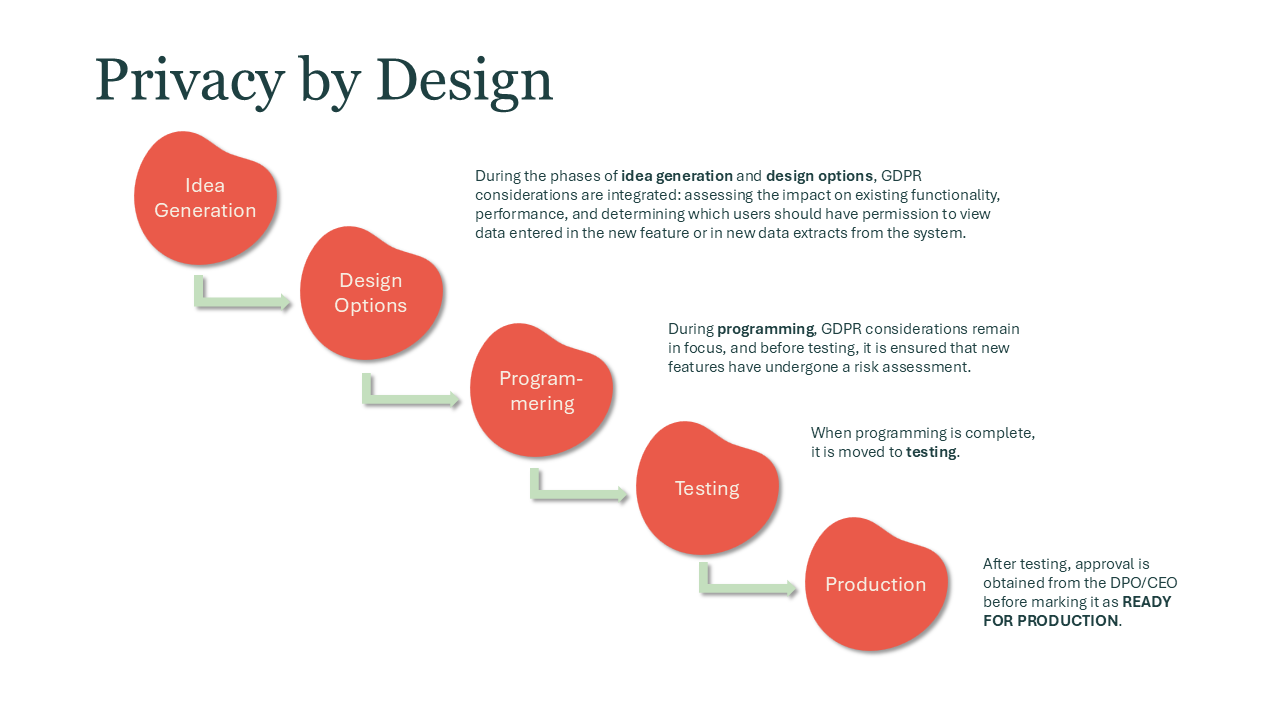
Privacy by Design
Evovia applies Privacy by Design principles throughout all stages of development, from concept creation to production.
Privacy by Default
The entire Evovia architecture is designed with confidentiality as a core principle. Employees are informed about who can access responses, meeting notes, and agreements. For example, meeting notes can only be viewed by the employee, their manager, and any individuals involved in the specific dialogue, while agreements may also be accessible to senior managers and HR.